

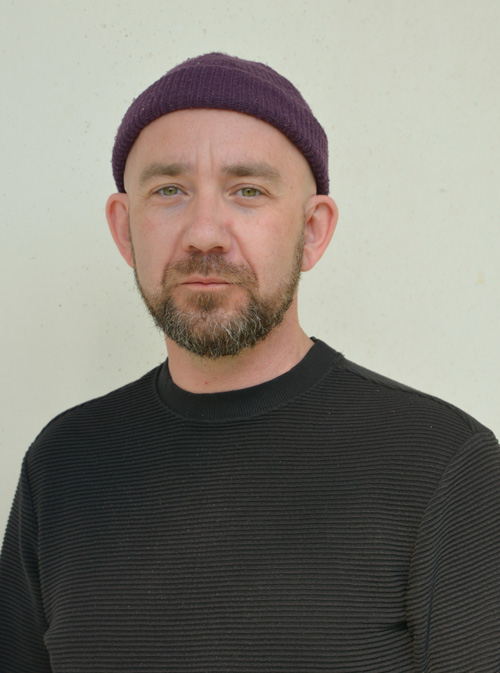
 © Victoria Collange, Enssib
Marcin Roszkowski is a associate professor at the Faculty of Journalism, Information and Book Studies at the University of Warsaw.
Interview with Marcin Roszkowski, visiting professor at Enssib
1. Could you introduce in a few sentences what your research topics are?
I am an assistant professor at the Faculty of Journalism, Information and Book Studies at the University of Warsaw. I have been working at the University of Warsaw since 2010. I also have professional experience as a librarian, having spent 10 years in an academic library and 3 years at the National Library of Poland.
I hold both a master’s degree and a doctorate in library and information science. My PhD dissertation focused on knowledge organization in networked information systems. At the University of Warsaw, I am responsible not only for research and teaching but also for developing the curriculum for the track “The Architecture of Information Spaces.”
I am a member of the International Society for Knowledge Organization and the Bibliographical Data Working Group (BiblioData WG) within the Digital Research Infrastructure for the Arts and Humanities (DARIAH).
My research interests focus on knowledge organization in networked environments. This includes the development and application of metadata schemes and ontologies, as well as the conceptual modeling of information systems. Currently, I am exploring knowledge organization in peer production systems such as Wikipedia and Wikidata. The latter is the largest community-developed knowledge graph, where both the ontology and the knowledge base are created collaboratively by a community of users. My work in this area focuses on community-driven ontology evolution and the epistemic practices that emerge within a decentralized knowledge graph.
2. How do you find the role of librarians in peer-production systems like Wikipedia and Wikidata?
I believe librarians play an important role in the development of peer-production systems like Wikipedia and Wikidata because they bring strong skills in information literacy and knowledge organization. These platforms rely on verifiable information, and librarians are trained to assess the credibility and reliability of sources. Their expertise helps improve the quality, accuracy, and accessibility of information available to the public.
Another important contribution librarians make is in improving digital literacy and public engagement. Many libraries organize workshops and edit-a-thons that teach people how to contribute responsibly to collaborative knowledge platforms. There are many examples of such initiatives within the “Wikipedia Loves Libraries” project, which encourages cooperation between libraries and Wikipedia communities.
From a broader perspective, it is also worth mentioning the GLAM Wiki initiative. In this project, memory institutions — Galleries, Libraries, Archives, and Museums — collaborate with Wikipedia editors to share digital resources with a global audience. These partnerships help increase public access to cultural and educational materials while supporting open knowledge initiatives.
Overall, these collaborations provide libraries with an excellent opportunity to improve the visibility of their collections and engage wider audiences through platforms such as Wikipedia and Wikidata. At the same time, they strengthen the role of libraries as trusted institutions that support free access to reliable information in the digital age.
3. Your research is focused on Wikipedia and Wikidata, but have you also contributed to these collections as a regular user?
Yes, I have, and I find it a very interesting experience to connect my research with practice. I have been editing both Wikipedia and Wikidata for several years. Most of my work on Wikipedia has involved adding infoboxes and references to articles. An infobox is a table that summarizes the content of a Wikipedia article in a structured format, usually displayed in the top-right corner of the page. It is an important element because it not only presents key information in a property–value format but also identifies the type of subject described in the article, such as a person, event, or organization. In other words, my work has focused on enriching Wikipedia content with structured metadata.
Another important aspect of my contribution has been supplying references to Wikipedia articles. This is especially valuable in maintaining the credibility and reliability of the content. Together with my students, I have participated in identifying unsourced statements and providing them with appropriate academic or reliable references. I consider this an important educational activity because it helps students develop skills in information evaluation, source verification, and responsible knowledge sharing.
My contributions to Wikidata have mainly focused on my home institution, the University of Warsaw. I have created hundreds of records related to doctoral dissertations and research projects affiliated with the university. This work involved organizing and structuring metadata to improve the visibility and accessibility of academic information within the Wikidata ecosystem.
In addition, I have participated in community discussions related to the development of Wikidata’s ontology and data structure. These discussions are important because they help shape standards for representing knowledge in a consistent and interoperable way. Overall, my experience as both a researcher and contributor has given me valuable insight into how collaborative knowledge platforms function in practice.
Propos recueillis par Sabah EL BAKKALI
Le 02 juin 2026